Pain that has lasted for months can affect everything from work and sleep to the things you love doing. If you’ve tried a few things already and you’re still sore, you’re not alone. We take the time to understand your whole story and work with you on a plan to help you move and live well again.
Understanding persistent pain
Pain is your body’s alarm system. It’s there to protect you, but it isn’t a simple measure of damage. Pain is created by the brain, and it reflects a mix of physical, emotional and social factors. It can carry on even after the tissues have healed.
Your brain also remembers pain pathways. The more often a pathway is triggered, the easier it is to trigger again, a bit like a well-worn track through the bush. Over time the alarm can become over-protective and more sensitive, so things that used to feel fine can start to hurt.
How we feel pain is also filtered through our thoughts about it, our past experiences, stress, sleep and even our personality. Persistent pain is real. The good news is that because the nervous system can learn, it can also unlearn, and understanding this is often the first step.
What scans can and can’t tell you
Scans such as x-rays and MRIs are very good at ruling out serious problems such as fractures, disease or tumours. They can’t explain why you are in pain. Many people have changes on their scans as they get older with no pain at all, so a change on a scan isn’t always the cause. A scan is just one piece of the puzzle.
What we see
- Foot, heel, ankle or leg pain that has lasted three months or more
- Pain that moves around or doesn’t match what scans show
- Very sensitive or burning pain, including nerve irritation
- Pain that has stopped you walking, exercising or working the way you’d like
- People who have tried several treatments without lasting change
How we help
Every plan is built around you and your goals, and usually combines several things:
- Time and explanation: we listen to your whole story, explain what we find in plain language, and help you make sense of your pain
- Graded movement: building activity and strength gradually, with room to move in our studio gym
- Footwear and load: footwear advice, and orthotics or bracing where they help you stay active
- Treatment options: such as laser (photobiomodulation) therapy for very sensitive or nerve-related pain, shockwave, dry needling and manual therapy, where appropriate
- Pacing: practical ways to plan your week so you can do more of what matters without big flare-ups
Changing the conversation with your pain
The words and thoughts we use about pain matter. When pain comes on, it’s natural to jump to worst-case thinking: “Here it goes again, I’ll have to cancel everything.” That fear can turn the volume up. Changing the story can help turn it down.
- Swap your words: try “I’m less comfortable than I’d like to be” instead of “I’m having a flare-up”, or describe a sensation as “pressure” rather than “stabbing”. Tight can become “not quite as loose as I’d like”.
- Talk back to it: like standing up to a bully, calmly tell your pain that you’ll handle this your way, rather than letting it take control.
- Question your thoughts: thoughts aren’t facts. If you catch yourself thinking “this will never get better”, ask whether you can be completely sure that’s true, and what might change if you believed it could improve.
- Fill your week with things you value: when we do things we enjoy, the brain has its own ways of turning pain down. Gently swapping avoidance for activities you care about helps unwind the cycle.


Getting through flare-ups
The goal isn’t to never have a flare-up again. It’s to know you can get through one with confidence and a plan. Be kind to yourself along the way, cut yourself a break and celebrate the small wins, because progress isn’t all or nothing.
Staying active: pain doesn’t always mean stop
Pain doesn’t always mean damage, and movement is usually one of the most helpful things you can do. Rather than telling you to stop, we teach you how to listen to your body and adjust, using a simple pain-monitoring guide.
- The 5 out of 10 guide: some discomfort while you exercise is acceptable. Aim to keep it at or below 5 out of 10 during exercise, straight afterwards and the next day. If it goes higher, ease off a little next time rather than stopping altogether.
- Your comfort changes day to day: sleep, food, stress and tiredness all affect how much you can do. Adjust your activity to how you feel on the day.
- Movement helps in more ways than one: it keeps your heart, joints and muscles strong, releases your body’s own natural pain relievers, and supports your mood and your connection with others.
- Some situations need more care: if you have reduced feeling in your feet (peripheral neuropathy), an open wound or a fracture, your podiatrist will give you stricter guidelines.
Over time this gives you the skills to manage and adapt your own activity, with us supporting you along the way. Read more about the pain-monitoring model.
Treatment options at The Foot Studio
Persistent pain is rarely about one thing, so we have a wide range of treatment options and combine them to suit you.
- Education and adviceUnderstanding your pain, and a plan you can manage yourself.
- Laser therapyPhotobiomodulation and high power laser to help calm sensitive tissues and nerves.
- Shockwave therapyFor longer-standing tendon and heel pain.
- Dry needlingFor tight, sore muscles and trigger points.
- Local anaesthetic injectionsFor irritated or trapped nerves, where appropriate. Not a steroid.
- Manual therapyHands-on mobilisation for stiff joints and soft tissues.
- Strength and exerciseA graded program in our studio gym.
- Gait retrainingVideo analysis on our treadmill to help you walk and run more comfortably.
- FootwearAdvice and fitting in our shoe and movement shop.
- Orthotics and bracingCustom orthoses, EXO-L and the Richie Brace where they help.
- Taping and paddingTo offload sore areas while they settle.
With so many options available, there’s a lot we can do to help you feel more comfortable. It all starts with a thorough assessment, a clear diagnosis and a plan we work out together.
Laser therapy
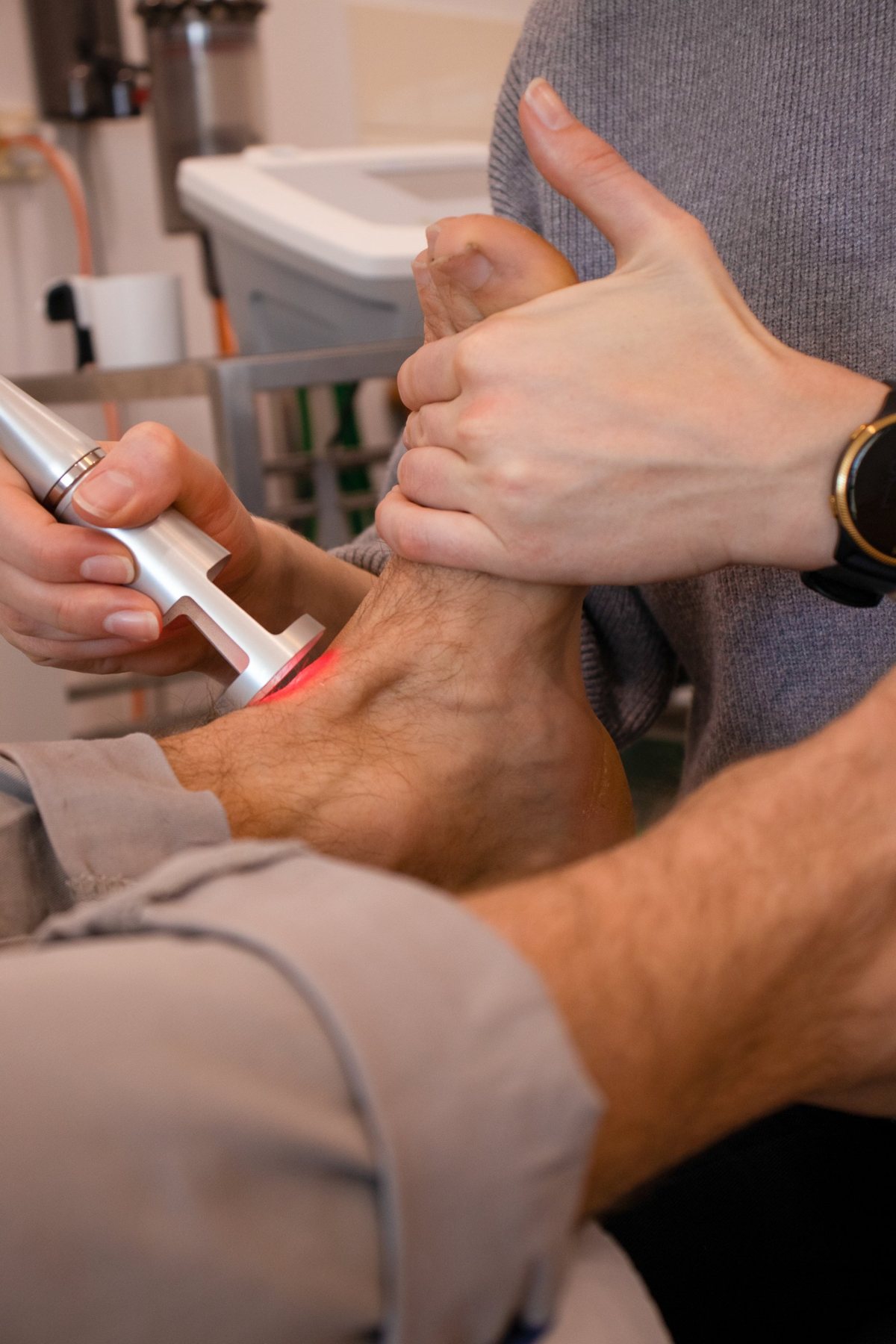
Laser is an option we often use for persistent pain, especially when tissues or nerves have become very sensitive. Photobiomodulation uses light to help reduce inflammation, support tissue repair and calm heightened nerve sensitivity. It’s gentle and non-invasive, and we usually combine it with movement and other care.
Local anaesthetic injections
If you describe burning or other nerve-type sensations, part of your pain may be coming from a nerve that has become irritated or trapped. For some people, a local anaesthetic injection can be a helpful part of their plan. It is local anaesthetic only, not a steroid.
Think of the nerve like a pool noodle squeezed into a bath. When it doesn’t have room to move, perhaps because of scar tissue around it, it can become sensitive and sore. The injection adds fluid around the nerve, a bit like moving the noodle from the bath into a pool, giving it more room and helping free it up. It can also help reset the brain so it stops treating that pain as normal.
Responses vary. Some people need more than one injection, spaced a few weeks apart, and we review how you’re going after each one. Injections are always combined with the rest of your plan, such as strengthening, footwear and orthotics, and we’ll talk through whether they’re suitable for you.
Working with your care team
Persistent pain is often best managed by a team. We regularly work alongside GPs, physiotherapists, psychologists and other health professionals, so everyone is working towards the same goals. If you have a GP Chronic Condition Management plan, you can use it for podiatry.
Sometimes advice is all you need
Not everyone needs treatment. Sometimes the most helpful thing is a clear explanation of what’s going on, practical advice and a plan you can manage yourself. We’ll always talk you through every option, including no treatment, so you can decide what’s right for you.

Frequently asked questions
Does pain mean I’m doing damage?
Not always. With persistent pain, the body’s alarm system is often more sensitive, so you can feel pain without ongoing damage. We’ll help you work out what is safe to do and how to build up gradually.
Are your injections steroids?
No. The injections we use for nerve-related pain are local anaesthetic only. We’ll explain how they work and whether they suit you at your assessment.
Will a scan show what’s causing my pain?
Scans are very good at ruling out serious problems, but they can’t explain why you are in pain. Many people have changes on scans with no pain at all, so a scan is just one piece of the puzzle.
I’ve tried everything. Can you still help?
Many people we see have tried several treatments. We take the time to look at the whole picture and work with you on a plan that suits you.
How long is the first appointment?
We allow time to hear your full story and assess you properly. Our team can tell you the length when you book.
Can I use a Medicare referral?
Yes. If your GP has given you a Chronic Condition Management referral, you can use it for podiatry and receive a Medicare rebate.
Do I need a referral?
No. You can book directly with one of our podiatrists.
Can I claim on private health?
We don’t offer on-the-spot claiming. If your extras cover includes podiatry, you can claim with your fund using your itemised receipt. Check with your fund about your level of cover.