The right shoe for someone with diabetes is one matched to their level of foot risk, and for higher-risk feet, one that has been shown to take pressure off the areas most likely to break down.
Diabetes can reduce feeling in the feet (neuropathy) and slow healing. That means a rub, blister or pressure spot can go unnoticed until it becomes a wound. Diabetes-related foot disease is a leading cause of hospital admission and amputation in Australia, with an estimated 300,000 Australians at risk of developing it each year (Medical Journal of Australia, 2023). Good footwear is one of the simplest ways to help lower that risk.
Here’s what the current Australian and international guidelines say, and what the research does and doesn’t support.
It depends on your risk level
There is no single “diabetic shoe”. Your podiatrist grades your foot risk at a diabetes foot check, and the footwear advice depends on it.
| Your situation | What the guidelines recommend |
|---|---|
| Reduced feeling or circulation, but no deformity or past ulcer | Well-fitting, protective shoes that accommodate the shape of your feet |
| Foot deformity (such as bunions or clawed toes) or callus and pre-ulcer spots | Medical grade footwear, often with custom insoles or toe orthoses |
| A healed ulcer on the sole of the foot | Medical grade footwear with custom insoles shown to reduce pressure where you walk, ideally checked with in-shoe pressure testing |
| An open ulcer | Shoes alone are not the treatment. An offloading device such as a cast or moon boot comes first |
The features with the best evidence
Most foot ulcers on the sole start where pressure is highest. The strongest research supports features that bring that pressure down.
Rocker soles
A stiff sole with a curved “rocker” under the forefoot lets the shoe roll you forward, so the ball of the foot carries less load. Of the design features studied, this has the strongest support for reducing pressure under the forefoot, and a clinical trial found a rigid rocker sole lowered the rate of ulcers coming back. Rocker soles do reduce some of your feel for the ground, so they aren’t right for everyone, particularly if your balance is poor.
Custom insoles
Insoles moulded to your foot, often with a small pad behind the ball of the foot, spread load away from high-pressure spots. Full contact between insole and foot matters.
Pressure testing
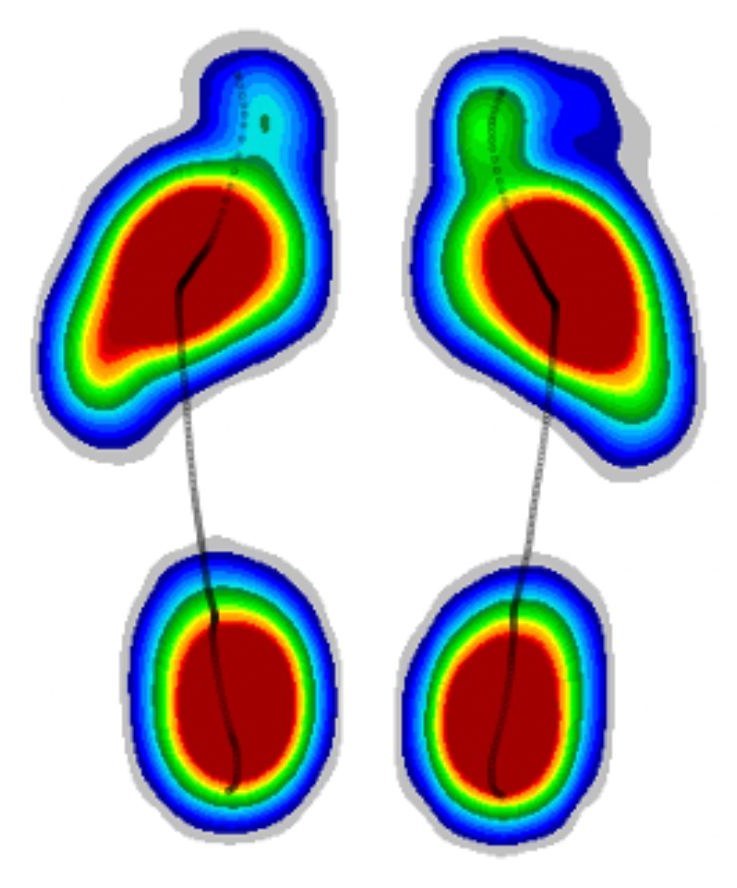
Research uses an in-shoe pressure target of about 200 kPa. Measuring pressure lets your podiatrist check the shoe and insole are doing their job, and fine-tune them if not. Pressure mapping on our Zebris treadmill also shows where load builds up under your feet as you walk.
A fit checklist for everyday shoes
If you have reduced feeling, you can’t rely on a shoe feeling comfortable in the shop. Check these instead:
- Length: about a thumb’s width between your longest toe and the end of the shoe, checked standing up
- Width: the widest part of your foot sits in the widest part of the shoe, without the upper bulging
- Depth: room for your toes to move, plus space for an insole if you use one
- Both feet: fit to the larger foot, and shop later in the day when feet are at their biggest
- Secure fastening: laces or straps that hold your foot in place so it doesn’t slide and rub
- Firm heel and sole: a heel cup that doesn’t collapse when squeezed, and a sole that bends at the ball of the foot rather than the middle
There’s no reliable “breaking in” period for a shoe that doesn’t fit. If it rubs or presses, it isn’t the right shoe.
What about seamless uppers and leather linings?
These are sensible features, but they haven’t been tested in studies that look at whether people actually get fewer ulcers.
Seamless or minimal-seam uppers make sense if you have toe or bunion deformities that press against the inside of the shoe. A soft, stretchy upper that moulds around a bony area does a similar job. The key is checking where any seams sit against your particular foot.
Leather linings can absorb moisture, but heavy finishing reduces this, and some lab testing suggests leather becomes grippier when damp from sweat. A breathable lining paired with moisture-wicking socks is a reasonable choice. Leather isn’t automatically better.
In short: nice to have, low risk, but fit and pressure relief matter far more.
The best shoe is the one you wear
Research shows people often wear their prescribed footwear only about half of their waking hours, and less at home, where many go barefoot or wear slippers. A 2026 study found people who didn’t wear their therapeutic footwear consistently were far more likely to have an ulcer return.
- Wear protective footwear indoors and outdoors if you’re at higher risk
- Always wear socks, ideally seamless and moisture-wicking, to reduce rubbing
- Check inside your shoes for stones or rough spots before putting them on
- Check your feet each time you take your shoes off, looking for redness, marks or blisters
- Have prescribed footwear reviewed regularly, as shoes and feet both change
For GPs and referrers
- The 2023 Australian diabetes-related foot disease guidelines adapt the IWGDF 2023 prevention guideline. Footwear recommendations are stratified by risk.
- The strongest footwear evidence is for preventing ulcer recurrence. Evidence for preventing a first ulcer is limited, and an older trial in patients without significant deformity found no benefit from therapeutic shoes over usual footwear.
- For a healed plantar ulcer, guidelines recommend footwear with demonstrated pressure relief during walking. In-shoe pressure measurement with a target near 200 kPa is the common benchmark.
- For an active plantar ulcer, footwear is last-line offloading. Non-removable knee-high devices are first-line.
- Please refer patients with loss of protective sensation, peripheral artery disease, deformity, or a history of ulcer or amputation for risk assessment and footwear prescription. How to refer →
Book a diabetes foot check
A diabetes foot check tells you your risk level, and that shapes everything about the right shoe for you. At The Foot Studio in Claremont, we check the feeling and circulation in your feet, look at how you walk and review the shoes you wear most. Bring them along.
Book a diabetes foot health assessment, or if staying active is your focus, a diabetes movement and pressure assessment. You can also read more about diabetes foot care.
References
- Bus SA et al. Guidelines on the prevention of foot ulcers in persons with diabetes (IWGDF 2023 update). Diabetes Metab Res Rev 2024.
- Lazzarini PA et al. Australian evidence-based guidelines for the prevention and management of diabetes-related foot disease: a guideline summary. Med J Aust 2023.
- Australian guideline on offloading treatment for foot ulcers. 2022.
- van Netten JJ et al. Diabetic Foot Australia guideline on footwear for people with diabetes. J Foot Ankle Res 2018.
- Plantar pressure thresholds as a strategy to prevent diabetic foot ulcers: a systematic review. Heliyon 2024.
- Footwear and insole design features that reduce neuropathic plantar forefoot ulcer risk: a systematic review.
- Clinical efficacy of therapeutic footwear with a rigid rocker sole in the prevention of recurrence: a randomized clinical trial.
- Effectiveness of therapeutic sport footwear in prevention of ulcer recurrence. 2026.
- Reiber GE et al. Effect of therapeutic footwear on foot reulceration in patients with diabetes. JAMA 2002.
- Shoe lining materials and hygienic properties. 2013.