When people think of a podiatrist, they often picture sore heels or tricky toenails.
Those are certainly part of it. But the concerns that walk through our door every week tell a bigger story about how our feet carry us through life.
Here are the five we see most often.
1. Pain under the ball of the foot
What it feels like: like walking on a pebble, or like your sock has bunched up under your toes. Some people notice tingling or numbness in their toes, especially in narrower shoes or heels.
What might be going on: there are several possible causes, and often it’s a combination:
- an irritated nerve between the toes, called a Morton’s neuroma
- an inflamed bursa, a small fluid-filled cushion under the joint
- a strain or tear in the ligament under a toe joint
- thinning of the natural fat pad under the forefoot, which happens as we get older
It often shows up alongside a bunion. The bunion is the part you can see, but there’s frequently more going on underneath. People with ball of foot pain often tell us they hate going barefoot, or that their floors at home feel “really hard”.
What helps in footwear: room, so nothing squeezes the forefoot, and support under the foot that takes pressure off the sore spot. A lower heel helps. A softer footbed in a narrow shoe usually won’t fix it.
When to see a podiatrist: if you have numbness or tingling, or the pain has lasted more than a few weeks.
2. Heel pain from being on your feet all day
Heel pain is especially common in people who stand or walk for most of their day: teachers, pharmacists, nurses, hospitality and retail teams, tradies and parents chasing toddlers.
What it feels like: pain on your first steps in the morning, or when you stand up after sitting. You hobble for a few steps and then it eases. Others notice it building at the end of a long day on hard floors.
Common misconceptions:
- “It’s plantar fasciitis.” It might be, but heel pain has several possible causes, including nerve irritation, fat pad bruising, stress fractures and the Achilles. The right treatment depends on the right diagnosis.
- “I’ve got a heel spur, that’s the problem.” Many people have heel spurs with no pain at all, and the spur usually isn’t what hurts.
- “Softer is better.” A squishy shoe can feel lovely at first and do little for a sore heel. Support and structure around the heel matter more.
- “It’ll go away if I push through.” Heel pain can hang around for months. Getting it looked at early makes a real difference.
Things that often make it worse: completely flat shoes, thongs and going barefoot on hard floors, which is why we see a spike every summer. Thin, hard-soled work shoes worn all day, and much-loved shoes with a collapsed heel or squashed footbed, can also play a part.
What helps in footwear: a firm heel counter that holds your heel in place, a contoured heel cup, cushioning under the heel and a small heel-to-toe drop. If you’re on your feet all day, rotating between two good pairs gives each one time to recover.
Not sure if your favourite pair has had its day? Bring them in. Our footwear fitters can check the heel and footbed for wear.
When to see a podiatrist: if it’s lasted more than a couple of weeks, or there’s swelling, pain at night, numbness or tingling, or it started after a big increase in walking.
3. Toes under pressure
“I can never find anything wide enough.” “Everything rubs on my bunion.” “My poor little toe.” Sound familiar?
This covers bunions, hammer or clawed toes, corns on and between the toes, and thick or ingrown nails.
When toes are squeezed into a shoe, the body is pretty smart: it lays down extra skin to protect itself, and that’s callus. Corns and hard skin are like a pressure map. They show exactly where your shoes aren’t fitting.
What helps in footwear: width and depth in the toe box, a soft upper without a seam over the sore joint, and adjustable fastening. Try to get the right width without simply going up a size in length. Feet often change size over the years as bunions and toes change shape, so have both feet measured.
Many people feel embarrassed about their toes or nails and hide them away. Please don’t be. These concerns are incredibly common, and they’re exactly what we’re here for.
When to see a podiatrist: if a toe is red, swollen or the redness is spreading, see a podiatrist soon.
4. Reduced feeling in your feet
Many people don’t know this is happening to them.
Reduced feeling happens when the nerves in the feet aren’t working as well as they should. Diabetes is one cause, but it can also come from low vitamin B12, heavy alcohol use and some medications, and it’s also part of normal ageing.
Why it matters: when your feet can’t feel properly, you might choose shoes that are too small or too tight, because you need that pressure to feel that a shoe fits. Blisters, rubbing and pressure areas can develop without you noticing.
What you might notice: you like your shoes “snug”, your feet feel like cotton wool or you get pins and needles, or you find a blister or mark you didn’t know was there.
What helps: have both feet measured, standing, whenever you buy shoes, and trust the measurement over the feel. Look for good depth, a smooth lining without seams that press, and adjustable fastening. Feet swell through the day, so shoe shopping later in the day is a good idea.
When to see a podiatrist: anyone with reduced feeling in their feet should have them checked regularly. Any wound, blister or colour change you hadn’t noticed needs to be seen quickly. Our Diabetes and your feet fact sheet has more on daily checks.
5. Staying steady on your feet
Many of our patients come to us simply to stay mobile, confident and independent. Foot pain, reduced feeling and the wrong footwear can all add to the risk of a fall.
It’s not always who you’d expect. We tend to picture a frail older person, but active, healthy older adults are at risk too: the person still climbing the ladder to clean the gutters, gardening and walking the dog. Research shows that more active older people tend to have their falls outdoors, often while doing exactly these things.
Then there’s the home. In a study of older people who broke a hip in a fall, slippers were the most common footwear being worn, and most people were wearing shoes with features that made them less stable, such as no fastening or a flexible heel. It often starts with a trip or near miss on the way to the bathroom at night. And many people don’t mention it: about half of older adults who fall don’t discuss it with their doctor.
Softer isn’t always safer. Many people believe a light, soft shoe is the safest choice. Research suggests older people are more stable in shoes with a low heel and a firm, slip-resistant sole.
Feet change with age, too. They often get wider, and for some people longer as the arch drops. If you’ve “always been a size 7”, it’s worth being measured again.
What helps in footwear: a firm heel counter, a secure fastening such as a strap, lace or zip, a low, broad heel, and a firm sole with good tread. Our footwear fitters look for these as part of every fitting, and a podiatrist is on site if you’d like your balance or feet checked too.
When to see a podiatrist: if you’ve had a trip, a near miss or a fall, or you’re feeling less steady, a podiatrist can assess your feet, footwear, strength and balance. Don’t wait for the signs, though. Looking after your feet and footwear early is part of staying active for longer.
Footwear and expert help, under one roof
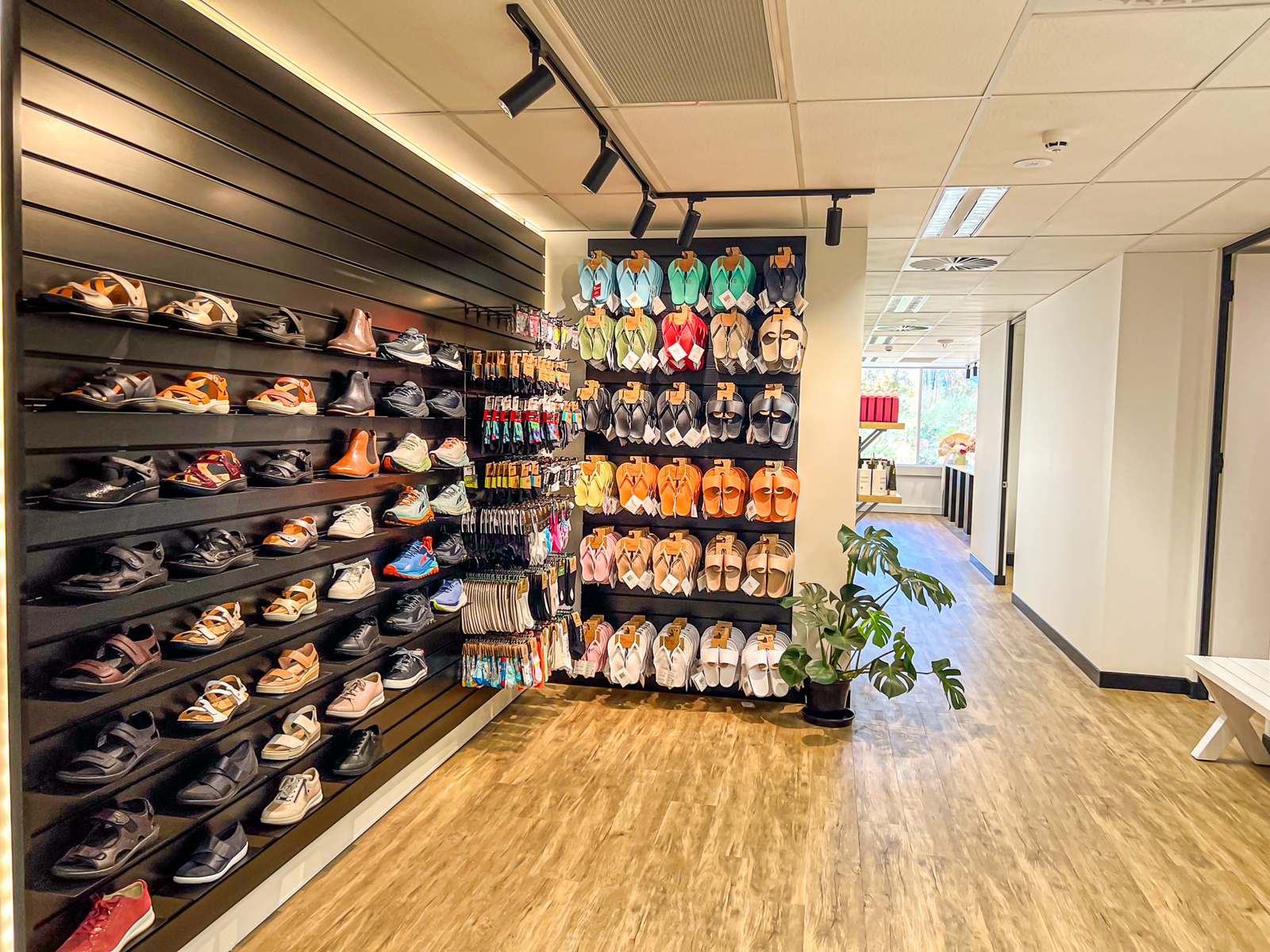
At The Foot Studio, our footwear and movement shop is on site, right next to our podiatry rooms. Our fitters are trained by our podiatrists, so they understand the concerns in this article: ball of foot pain, sore heels, toes under pressure, reduced feeling and staying steady on your feet.
They’ll measure both feet, ask what’s not working in your current shoes and what you need them for, and help you find a pair that fits well and that you’ll actually love wearing.
And if something needs a closer look, a podiatrist is on site to check in. That might be a sore spot, a nail, a mark you hadn’t noticed, or whether an orthotic will fit in your new shoes. If you need a full assessment, we’ll help you book one.
The right shoe matters
There’s a saying: “A new pair of shoes can change your life. Just ask Cinderella.”
Every shoe needs to be three things: comfortable, well fitted, and something you love and will actually wear. The best shoe in the world won’t help if it stays in the cupboard. It’s less about “good” and “bad” shoes, and more about the right shoe for the right activity.
If any of these sound familiar, you don’t need a referral to see us. Book a Skin & Nails or Pain & Movement appointment, or pop into our footwear and movement shop for a fitting. Read our What to expect at your first appointment fact sheet before you come.
References
- Sherrington C, Menz HB. An evaluation of footwear worn at the time of fall-related hip fracture. Age and Ageing. 2003;32(3):310-314.
- Menant JC, Steele JR, Menz HB, Munro BJ, Lord SR. Optimizing footwear for older people at risk of falls. Journal of Rehabilitation Research and Development. 2008;45(8):1167-1182.
- Kelsey JL, et al. Indoor and outdoor falls in older adults are different. Journal of the American Geriatrics Society. 2010.
- Bergen G, Stevens MR, Burns ER. Falls and fall injuries among adults aged 65 years and over, United States, 2014. MMWR. 2016;65(37).