Feels like walking on a pebble? Or like your sock has bunched up under your toes? Pain, burning, numbness or general discomfort across the ball of the foot is one of the most common reasons people see a podiatrist.
What it feels like
Some people feel a sharp or aching pain under the ball of the foot. Others notice burning, tingling or numbness in the toes, especially in narrower shoes or heels. People with ball of foot pain often tell us they hate going barefoot, or that their floors at home feel “really hard”.
Metatarsalgia isn’t really a diagnosis
Metatarsalgia is a common word used to describe pain across the metatarsals, or the ball of the foot. It tells us where it hurts, not why. So the first step is working out what’s causing it, and often it’s a combination.
What might be going on
- an irritated nerve between the toes, called a Morton’s neuroma
- an inflamed bursa, a small fluid-filled cushion under the joint (bursitis)
- a strain or tear in the ligament under a toe joint, called a plantar plate injury
- irritation of the small bones under the big toe joint, called sesamoiditis
- thinning of the natural fat pad under the forefoot, which happens as we get older
It often shows up alongside a bunion or toes that curl or claw. The bunion is the part you can see, but there’s frequently more going on underneath.
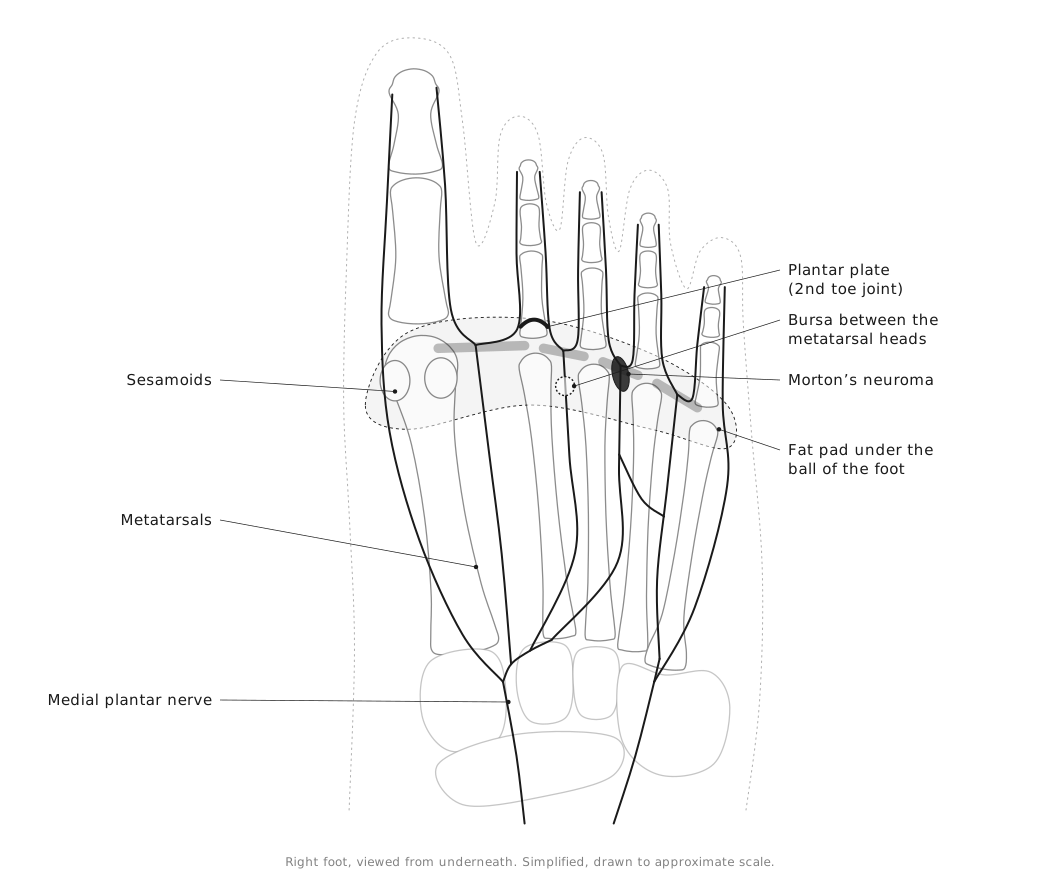
Bursitis under the ball of the foot
A bursa is a small fluid-filled cushion that helps tissues glide over each other. Under the ball of the foot it can become inflamed with repeated pressure, and the area can feel swollen, tender or bruised. We look at what’s loading the area, and management may include offloading, padding, footwear changes and orthoses.
Fat pad thinning
The natural cushioning under the ball of the foot thins as we get older, so the area can feel bruised or like walking on bone, especially barefoot or on hard floors. We may use cushioned, supportive footwear, padding and orthoses to take pressure off the area.
How we may help
A proper assessment comes first, so we can work out the right plan with you. Depending on what’s going on, options may include:
- footwear advice, such as a wider forefoot or a rocker sole
- taping, padding and offloading
- orthoses
- mobilisation and dry needling
- an exercise program
- laser (photobiomodulation) to help calm sensitive tissues and nerves
- injection therapy, where appropriate
What helps in footwear
Room, so nothing squeezes the forefoot, and support under the foot that takes pressure off the sore spot. A lower heel helps. A softer footbed in a narrow shoe usually won’t fix it. Our Footwear Fitting Crew can help you find shoes with the right shape and support.
When to see a podiatrist
If you have numbness or tingling, or the pain has lasted more than a few weeks. If you have diabetes or reduced feeling in your feet, have any new pain or change checked promptly.
Sometimes advice is all you need
Not everyone needs treatment. Sometimes the most helpful thing is a clear explanation of what’s going on, practical advice and a plan you can manage yourself. We’ll always talk you through every option, including no treatment, so you can decide what’s right for you.
This page is general information, not a diagnosis. For advice about your feet, see one of our podiatrists. Last reviewed November 2026 by The Foot Studio podiatry team.
Frequently asked questions
Is metatarsalgia the same as Morton’s neuroma?
Not quite. Metatarsalgia describes pain across the ball of the foot. A Morton’s neuroma is one possible cause, along with bursitis, plantar plate injury, sesamoiditis and fat pad thinning.
Why does it hurt more barefoot?
Without the cushioning and support of a shoe, more pressure goes through the ball of the foot, especially on hard floors.
Can I keep exercising?
Often yes, with some changes. We’ll talk you through how to keep moving while the area settles.
Do I need a referral?
No. You can book directly with one of our podiatrists.
Can I claim on private health?
We don’t offer on-the-spot claiming. If your extras cover includes podiatry, you can claim with your fund using your itemised receipt. Check with your fund about your level of cover.
Assessment notes, differentials, referral points and our treatment guidelines for this condition are in The Foot Studio clinician training area.
Clinician log in (coming soon)References and further reading
- van Dijk BT, Dakkak YJ, Matthijssen XME, et al. Intermetatarsal bursitis, a novel feature of juxtaarticular inflammation in early rheumatoid arthritis. Arthritis Care & Research, 2022. Full text