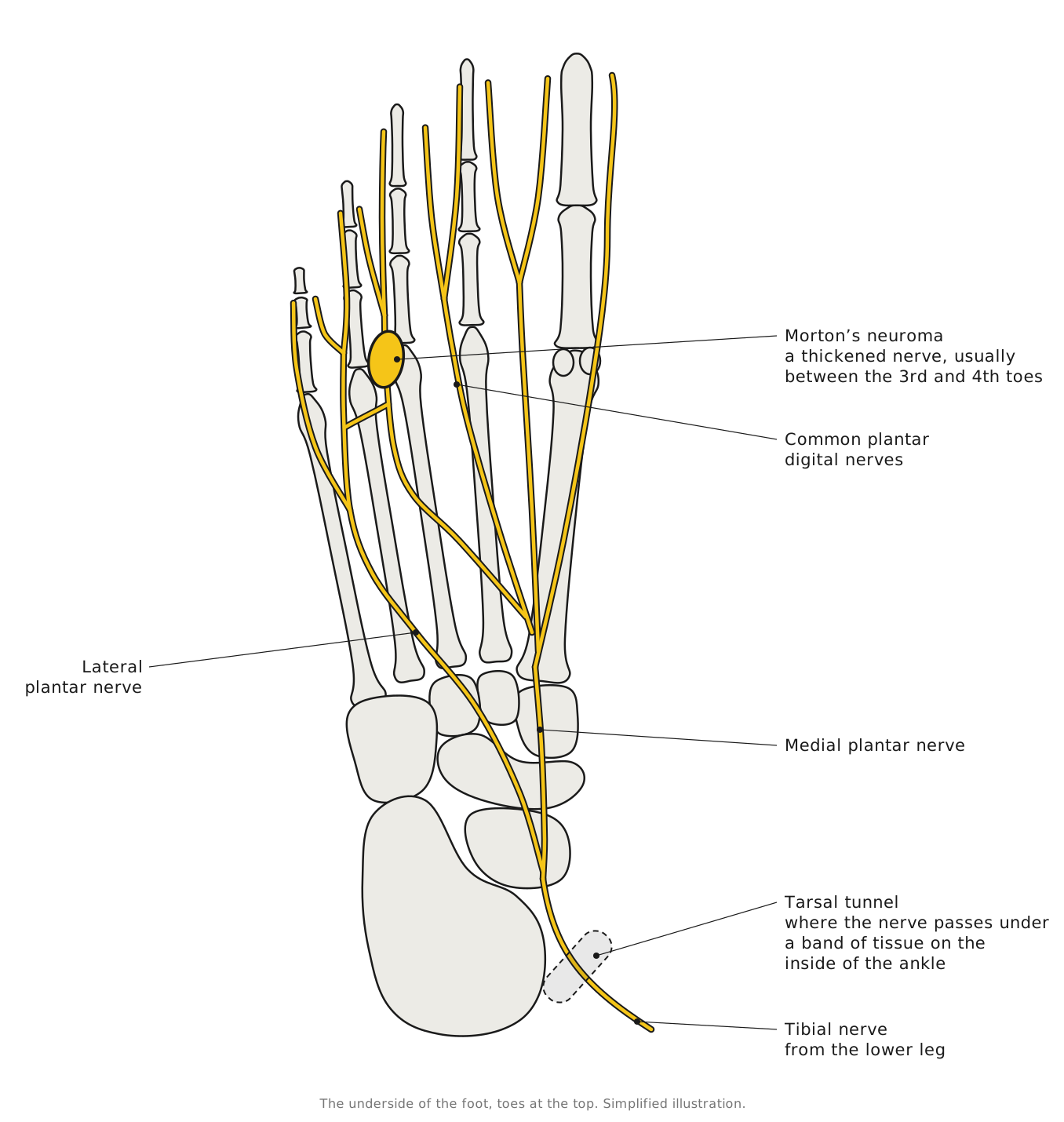
A Morton’s neuroma is an irritated, thickened nerve between the toes, most often between the third and fourth. It can feel like burning, tingling or numbness into the toes, or like walking on a pebble. Sometimes it can also “click” between the toes. It’s often worse in narrow or high-heeled shoes.
What is a Morton’s neuroma?
The nerves that supply your toes run between the long bones of the forefoot (the metatarsals). When one of these nerves is squeezed or irritated over and over, it becomes inflamed and scar-like tissue (fibrosis) forms around it. It’s often described as a benign (non-cancerous) thickening of the nerve. Despite the name, it isn’t a true tumour, because the nerve cells aren’t growing abnormally. It’s one of the common causes of ball of foot pain.
What it feels like
- burning, tingling or pins and needles into two neighbouring toes
- numbness in the toes
- a feeling like a pebble or a folded sock under the ball of the foot
- a “click” between the toes, especially when the front of the foot is squeezed
- pain that eases when you take your shoe off and rub your foot
Why it happens
Common contributors include narrow or pointed shoes, high heels, activities that put a lot of load through the forefoot, tight calves (reduced ankle movement), and the way your foot moves and takes load. It can also sit alongside other forefoot problems, such as an inflamed bursa under the same joints, a plantar plate tear, thinning of the fat pad under the ball of the foot, or a bunion.
Women are affected around four times more often than men, most often in middle age. Footwear is thought to play a big part.
Hypermobility. Some feet move more than usual. This can be just in the front of the foot, part of being flexible all over (generalised joint hypermobility), or linked to a connective tissue condition such as Ehlers-Danlos syndromes. Extra movement through the forefoot, especially around the big toe joint, can change how load spreads across the ball of the foot. Research hasn’t looked at Morton’s neuroma in hypermobility specifically, but it’s something we check for. If you know you’re hypermobile, let us know at your appointment.
Inflammatory conditions. Some inflammatory conditions, such as rheumatoid arthritis, can cause swelling of the small cushion (bursa) between the toes, or occasionally a small nodule. This can feel very similar to a Morton’s neuroma, or sit alongside one. If you have an inflammatory condition, let us know at your appointment. It helps us work out what’s going on, and whether imaging or other tests would be useful.
Why is it most common between the 3rd and 4th toes?
No one knows for sure. There are a few theories, and it’s likely a mix of them.
- Two nerves joining. In some people, a small branch from the nerve on the outer side of the foot joins the nerve running to the 3rd and 4th toes, which was thought to make it thicker there. A cadaver study found this connecting branch in only about 1 in 4 feet, and the nerve wasn’t thicker when it was there, so it’s unlikely to be the whole story.
- Movement between the bones. The 3rd metatarsal is held more firmly in the middle of the foot, while the 4th moves more with the outer side of the foot. The nerve sits between them, so it may be rubbed or pinched more with every step.
- A tight space. The spaces between the 2nd, 3rd and 4th metatarsals are narrower than the others. The nerve runs under a strong band of tissue joining the metatarsal heads (the deep transverse metatarsal ligament), and it may be squeezed against its edge, especially when the toes bend up, such as in heels or when pushing off.
- A nearby bursa. The small cushions (bursae) between the metatarsal heads are larger in the 2nd and 3rd spaces. If they become inflamed or swollen, they may press on or irritate the nerve.
A neuroma between the 2nd and 3rd toes is more common than many people think, too. In the same cadaver study, neuroma changes were found in the 2nd space almost as often as in the 3rd.
How we assess it
Ball of foot pain often has more than one cause, so a forefoot assessment looks at the whole area, not just the sore spot. It usually includes:
- Your story: where it hurts, what it feels like, what makes it better or worse, your activity and general health
- Feeling the structures: gently pressing (palpating) between and under the metatarsal heads, the toe joints and the surrounding tissues to find where the pain comes from
- Mulder’s click: squeezing the front of the foot while pressing between the metatarsal heads, which can produce a click and reproduce your symptoms when a neuroma is present
- Checking the plantar plate: testing the ligament under the toe joints, as a plantar plate injury is a common cause of similar pain and can be present at the same time
- Big toe joint movement: checking how well your big toe joint bends and works. If it isn’t functioning as it should, the rest of the forefoot can end up taking more of the load, and unevenly, which can add pressure around the nerve
- Foot and ankle range of motion: including ankle and calf flexibility, which can affect how much load goes through the ball of the foot
- Gait assessment: watching how you walk, and run if that’s relevant, to see how your feet take load
- Checking the nerves higher up: gently tapping over the nerve on the inside of the ankle (Tinel’s sign) to make sure the symptoms aren’t coming from a trapped nerve higher up, such as in the tarsal tunnel
- Footwear assessment: looking at the shoes you wear most, including the width and depth of the toe box, heel height, how much cushioning and support they have, and how they’re wearing, as footwear often plays a big part with this condition
If we need more information, or to rule out other causes, we can refer you for imaging, such as an ultrasound, X-ray or MRI.
How we may help
A proper assessment comes first, so we can work out the right plan with you. Depending on what’s going on, options may include:
- footwear advice, such as a wider forefoot, a lower heel or a rocker sole, plus supportive thongs for summer
- taping and padding to take pressure off the nerve
- orthoses
- mobilisation and dry needling
- an exercise program
- high powered laser (photobiomodulation), never on its own, but alongside gentle mobilisation, taping and offloading, footwear changes and exercises
- injection therapy, where appropriate
About injections
If an injection is an option for you, we’ll talk you through the choices. A 2024 Cochrane review of the research found that, at 3 to 6 months, adding a corticosteroid (cortisone) to a local anaesthetic injection made little to no difference to pain or function compared with local anaesthetic alone. Cortisone injections had more side effects, such as thinning of the skin or fat pad, or lighter skin where the injection was given. The evidence is still limited, so we look at what suits you. Read the Cochrane review summary.
If things aren’t settling, we work with your GP, sports doctors and surgeons, and refer on when that’s the right next step.
What you can do at home
- Choose shoes with a wide, deep toe box and a lower heel
- Loosen the laces across the front of your shoes
- Take breaks from tight or dressy shoes, and swap them out when you can
When to see a podiatrist
If you have numbness or tingling in your toes, or the pain has lasted more than a few weeks. If you have diabetes or reduced feeling in your feet, have any new pain or change checked promptly.
Love walking barefoot on the beach?

Love a barefoot walk on the beach, but find you can’t go without your shoes or orthotics? Barefoot isn’t for everyone, but we know how much the activities you love matter to you. If you’re comfortable in your footwear and orthotics day to day, but a walk on the sand is still out of reach, talk to us. There are other options we can work through together.
Sometimes advice is all you need
Not everyone needs treatment. Sometimes the most helpful thing is a clear explanation of what’s going on, practical advice and a plan you can manage yourself. We’ll always talk you through every option, including no treatment, so you can decide what’s right for you.
This page is general information, not a diagnosis. For advice about your feet, see one of our podiatrists. Last reviewed November 2026 by The Foot Studio podiatry team.
Frequently asked questions
Is a Morton’s neuroma a tumour?
It’s often described as a benign (non-cancerous) growth, but it isn’t a true tumour. It’s an irritated nerve with thickened, scar-like tissue around it.
Do I need a scan?
Not always. We can often assess it in the clinic, and refer you for imaging, such as an ultrasound, X-ray or MRI, if we need more information or want to rule out other causes.
Is a cortisone injection better than a local anaesthetic injection?
Not necessarily. A 2024 Cochrane review found that adding cortisone to a local anaesthetic injection made little to no difference to pain or function at 3 to 6 months, and cortisone had more side effects. We’ll talk you through the options if an injection is right for you.
Will I need surgery?
Surgery isn’t a first step. We start with options like footwear changes, offloading and orthoses, and talk with you about referral if things aren’t settling.
Do I need a referral?
No. You can book directly with one of our podiatrists.
Can I claim on private health?
We don’t offer on-the-spot claiming. If your extras cover includes podiatry, you can claim with your fund using your itemised receipt. Check with your fund about your level of cover.
Assessment notes, differentials, referral points and our treatment guidelines for this condition are in The Foot Studio clinician training area.
Clinician log in (coming soon)References and further reading
- Matthews BG, Thomson CE, Harding MP, McKinley JC, Ware RS. Treatments for Morton’s neuroma. Cochrane Database of Systematic Reviews, 2024. Cochrane summary
- Matthews BG, Hurn SE, Harding MP, Henry RA, Ware RS. The effectiveness of non-surgical interventions for common plantar digital compressive neuropathy (Morton’s neuroma): a systematic review and meta-analysis. Journal of Foot and Ankle Research, 2019. PubMed
- de Oliveira HAV, Natour J, Vassalli M, Rosenfeld A, Jennings F, Jones A. Effectiveness of customized insoles in patients with Morton’s neuroma: a randomized, controlled, double-blind clinical trial. Clinical Rehabilitation, 2019. PubMed
- Corticosteroid plus local anaesthetic versus local anaesthetic alone for Morton’s neuroma: a randomised controlled trial. PubMed
- Naraghi R, Bremner A, Slack-Smith L, Bryant A. The relationship between foot posture index, ankle equinus, body mass index and intermetatarsal neuroma. Journal of Foot and Ankle Research, 2016. Full text
- Larsen SB, Offersen CM, Dyrberg E, et al. Morton’s neuroma or intermetatarsal bursitis: a prospective diagnostic study of intermetatarsal pain. Diagnostics, 2025. Abstract
- van Dijk BT, Dakkak YJ, Matthijssen XME, et al. Intermetatarsal bursitis, a novel feature of juxtaarticular inflammation in early rheumatoid arthritis. Arthritis Care & Research, 2022. Full text
- Chaganti S, Joshy S, Hariharan K, Rashid M. Rheumatoid nodule presenting as Morton’s neuroma. Journal of Orthopaedics and Traumatology, 2013. Full text
- Altered multisegment ankle and foot kinematics during gait in patients with hypermobile Ehlers-Danlos syndrome/hypermobility spectrum disorder: a case-control study, 2020. PubMed
- Morton neuroma: epidemiology and risk factors. Medscape Reference. Medscape
- Morton’s neuroma. Frontline Foot and Ankle (open textbook). Chapter
- Levitsky KA, Alman BA, Jevsevar DS, Morehead J. Digital nerves of the foot: anatomic variations and implications regarding the pathogenesis of interdigital neuroma. Foot & Ankle, 1993. PubMed
- Gauthier G. Thomas Morton’s disease: a nerve entrapment syndrome. A new surgical technique. Clinical Orthopaedics and Related Research, 1979.
- Bossley CJ, Cairney PC. The intermetatarsophalangeal bursa: its significance in Morton’s metatarsalgia. Journal of Bone and Joint Surgery (British), 1980. Abstract
- Theumann NH, Pfirrmann CW, Chung CB, et al. Intermetatarsal spaces: analysis with MR bursography, anatomic correlation, and histopathology in cadavers. Radiology, 2001.