What is pain?
Pain is your body’s protection system. It’s always real. It’s your brain’s way of telling you something might need attention. Your brain weighs up messages from your body along with your thoughts, feelings, memories and surroundings, then decides how much protection you need.
Meet your sunflower
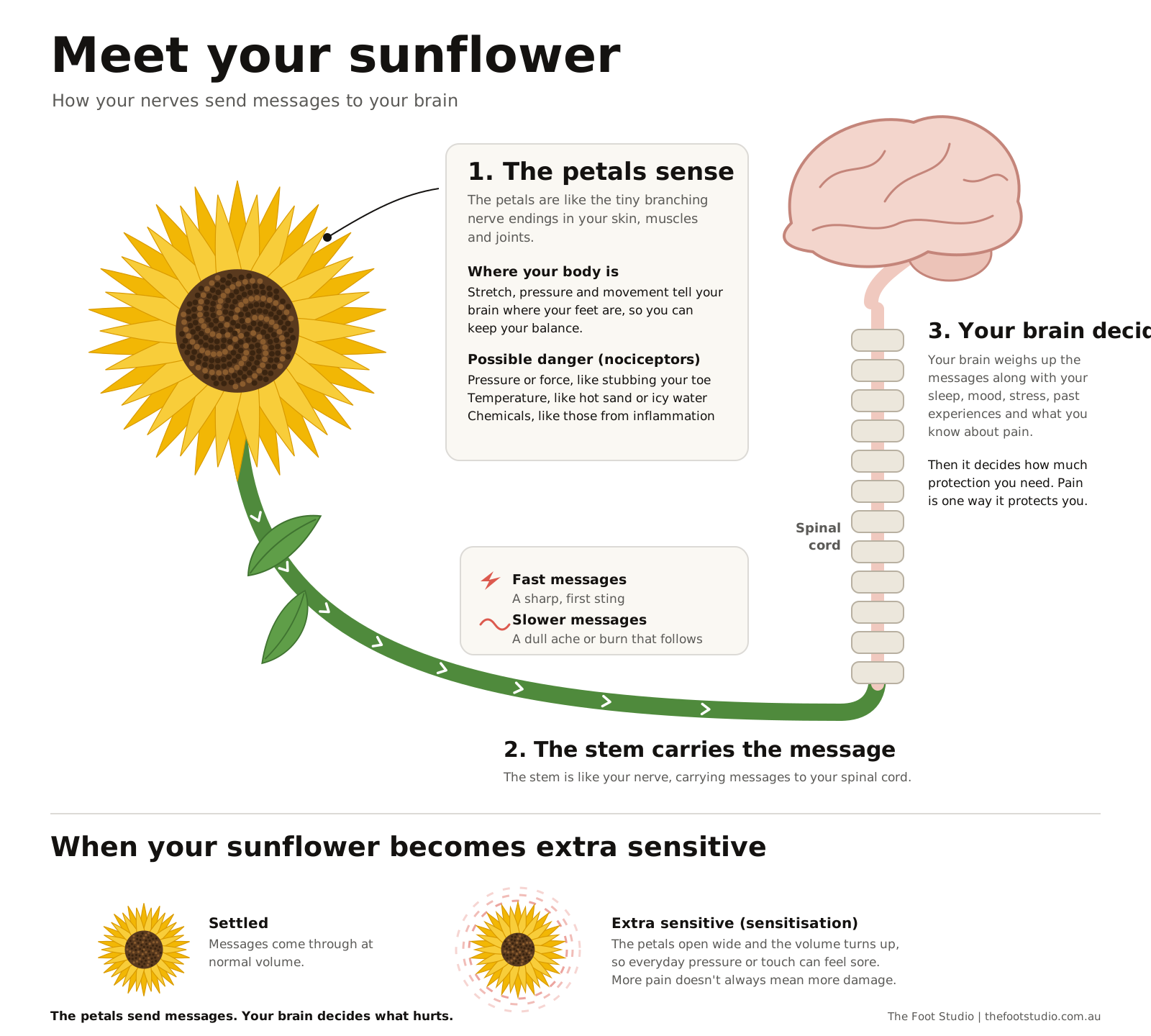
Picture each of your sensory nerves as a sunflower. The petals reaching out are like the tiny branching nerve endings in your skin, muscles and joints. They sense the world around you and send messages along the stem, your nerve, to your spinal cord and brain.
1. Where your body is (proprioception)
Some petals sense stretch, pressure and movement in your muscles, tendons, joints and the soles of your feet. This tells your brain where your feet are and how to keep your balance, even with your eyes closed.
2. Possible danger (nociception)
Other petals, called nociceptors, watch for pressure or force (like stubbing your toe), temperature (like hot sand or icy water) and chemicals (like those released when tissue is inflamed).
Fast messages feel like a sharp first sting. Slower ones feel like a dull ache or burn. These are danger messages, not pain itself.
What normal pain and recovery look like
When you injure a tissue, like spraining an ankle, your body follows a healing process.
Inflammation
The area may be swollen, warm and sore. This is your body bringing in what it needs to heal. Pain is usually highest here and helps you protect the area.
Repair
New tissue is laid down and pain usually eases. Gentle movement helps the new tissue grow strong.
Remodelling
The tissue gets stronger as you gradually load it. You may feel some discomfort as you return to more activity.
Recovery is rarely a straight line. Good days and harder days are normal, and a sore day doesn’t mean you’ve gone backwards. Most tissues heal within about 3 months.
Why pain is different for everyone
No two people feel pain the same way, and your own pain can change from day to day. Things that can turn the volume up or down include:
- Sleep: poor sleep can make pain feel worse, and pain can make sleep harder
- Mood and stress: worry, low mood or pressure can turn the volume up
- Movement and exercise: regular movement, built up gradually, can help turn the volume down for many people
- Past experiences with pain: what we’ve been through before shapes how our brain reads new messages
- Understanding pain: knowing what pain is can make it feel less threatening
Every nervous system is different
Everyone’s sunflower is set a little differently. Some people are naturally more sensitive to touch, temperature or pressure, and others notice less. Sensitivity can also change over your life and from day to day. Both are normal, and knowing how your own body responds helps us tailor your care.
Many neurodivergent people, including autistic people and people with ADHD or sensory processing differences, experience their senses differently. You might:
- find some touch, textures, sock seams or shoes overwhelming or painful
- notice pain less, or not notice an injury straight away
- find it hard to describe where pain is or how it feels
- show pain differently from what others expect
None of this is wrong. Let us know what you notice and what helps you feel comfortable, and we’ll adapt your care. See Neurodiversity, Disability & Your Feet.
Peripheral sensitisation
After an injury, the nerve endings near the area become more sensitive, often because of chemicals released during inflammation. It’s like the petals opening wider to catch every bit of light, so light pressure can feel sore. This usually settles as the tissue heals.
Central sensitisation
The spinal cord and brain turn up the volume on the messages coming in. Normal messages can feel painful, pain can spread to a wider area, and touch or movement that shouldn’t hurt can feel sore. This can happen even after tissues have healed.
More pain doesn’t always mean more damage.
When your sunflower wilts: nerve loss
Pain protects us, so losing feeling can be risky. When nerves are damaged, the petals start to wilt and send fewer messages. This is called peripheral neuropathy. You might not feel a blister, cut, stone in your shoe or hot surface, and small problems can become serious before you notice them.
Nerve loss usually starts in the feet. Common causes include:
- diabetes
- some medications, including chemotherapy
- vitamin B12 deficiency
- long-term heavy alcohol use
- ageing, which can gradually reduce feeling in the feet
Some people notice numbness, tingling, burning or pins and needles, while others notice nothing at all. Nerve loss can also affect your balance, because your brain gets less information about where your feet are.
If you have reduced feeling, check your feet every day, wear well-fitting shoes, and have regular foot checks with your podiatrist. See Diabetes and your feet.
What is chronic pain?
Chronic, or persistent, pain is pain that lasts or keeps coming back for more than 3 months. Often the nervous system has become more sensitive, so pain can carry on after tissues have healed. Around 1 in 5 Australians aged 45 and over live with ongoing pain.
Scans are one piece of the puzzle
X-rays, ultrasounds and MRIs are very useful for ruling out serious problems. But many changes found on scans, like wear and tear, are also common in people with no pain at all, especially as we age. A finding on a scan doesn’t always explain your pain.
Your podiatrist looks at the whole picture. This is also why it’s important to see a health professional trained in the biopsychosocial model of care, someone who looks at your body, mind and life together, rather than interpreting the scan alone.
Fear of movement and how you walk
What is kinesiophobia?
Kinesiophobia means a strong fear of movement or activity, because of a worry that it will cause pain or injury. It makes sense to protect a sore area early on. But if that fear stays, people often start avoiding movement. Less movement can lead to stiffness, weakness and more sensitivity, which can make pain and fear grow.
How it changes the way you walk
When we’re worried about pain, the body often protects the sore area without us realising. You might:
- put less weight through the sore foot or leg
- take shorter or slower steps
- stiffen your ankle or avoid pushing off through your toes
- limp, or lean away from the sore side
This is called gait compensation. It’s helpful early on. If it carries on after healing, it can load other areas, like your other foot, knee, hip or back. It can also keep the sore area weak and sensitive. Your podiatrist can look at how you walk and help you gradually return to moving with confidence.
Complex regional pain syndrome (CRPS)
CRPS is a condition where pain is much greater than expected from the original injury. It usually affects an arm or a leg, and often comes after an injury, a fracture, surgery or time in a cast or boot. As well as pain, people may notice:
- touch, clothing or bedsheets feeling painful
- changes in skin colour or temperature
- swelling or changes in sweating
- changes in the skin, hair or nails
- stiffness or difficulty moving
It’s diagnosed by a doctor. Care usually focuses on gentle movement, desensitisation and support from a team. Many people improve, and getting help early matters.
What is FND?
Functional neurological disorder (FND) is a condition where the brain and nerves are healthy in structure, but aren’t sending and receiving messages the way they should. Your sunflower is healthy, but the messages get mixed up along the way. FND can affect walking, balance and how your feet feel, so a podiatrist can be part of your care team.
Symptoms are real and aren’t under a person’s control. They can include leg weakness, changes in walking or balance, numbness, pain, tremor and fatigue.
FND is diagnosed more often in women, and research suggests it may be more common in neurodivergent people. Care usually involves a team. FND Australia has more information.
Helping your sunflower settle
- Learning about pain, like you’re doing now
- Gentle, regular movement, built up gradually
- Sleep, rest and ways to manage stress
- Doing things you enjoy and value
- Telling us about your sensory needs so we can adapt your care
- Footwear and a plan that fit your life
- Working with your podiatrist and wider health team
Learning about pain tends to help most alongside movement and exercise. The toolkit below has practical tools to try.
Simple tools to help your sunflower settle. Try one at a time, and keep the ones that work for you. The PDF version has space to write your own answers.
Word swap
The words we use create pictures in our mind, and those pictures shape how threatening pain feels. Swapping alarming words for calmer ones can help turn down the alarm. Try describing what you feel by its opposite, the comfort you’re working towards.
| Instead of | Try |
|---|---|
| “I’m having a flare up” | “I’m less comfortable than I’d like to be” |
| “Pain” | “Sensation” or “pressure” |
| “Burning” | “Not quite as cool as I’d like it to be” |
| “Stabbing” | “Not quite as cushioned as I’d like it to be” |
| “Aching” | “Not quite as soothed as I’d like it to be” |
| “Tight” | “Not quite as loose as I’d like it to be” |
Talking to your pain
When we feel pain coming on, it’s easy to jump to scary thoughts: “Oh no, here it comes. I won’t be able to work tomorrow. I’ll have to cancel everything.” These thoughts set off the body’s alarm system and can turn the pain up.
Think of pain like a bully at the park who takes your lunch money. If you hand it over every time, the bully keeps coming back. Calmly standing your ground changes the pattern. Try saying:
“I see what you’re trying to do. I’m going to handle this my way.”
“I know this feels scary right now, but I can handle it. I’m okay.”
The goal isn’t zero flare ups. The goal is knowing you can get through them.
Thought check
Thoughts aren’t facts. When a big thought shows up, like “My pain is never going to get better”, ask yourself:
- Is this definitely true?
- What would I feel like if I believed my pain could improve?
- What’s a more helpful way to say it? For example, “My pain can change, and I’m learning how to help it settle.”
Watch out for all-or-nothing thinking, like “if I can’t do it all, there’s no point”. Celebrate small wins and give yourself a break.
Fill your life with good things
What we pay attention to grows. Doing things you enjoy and value, like time with people, being outdoors, hobbies and gentle movement, helps your brain turn down pain naturally. It also gives pain less space in your day.
Pain monitoring model
Pain doesn’t always mean stop. It means listen. Some discomfort during exercise is usually safe and part of getting stronger. Use these three checks:
| Check | Green light | Time to adjust |
|---|---|---|
| During activity | 0 to 5 out of 10 | Above 5 out of 10 |
| Next morning | Back to your usual level | Still higher than usual |
| Week to week | Staying the same or improving | Pain or stiffness building up |
If you get a “time to adjust”, don’t stop completely. Ease back on how far, how fast or how often, or try a different activity, then build up again. Your comfort level can change with sleep, food, stress and tiredness, so adjust day to day.
Not for everyone: this model isn’t suitable for every condition. Follow your podiatrist’s specific advice if you have a fracture or bone stress injury, peripheral neuropathy, an open wound or infection, or CRPS.
Your tracker and settle plan
The PDF version includes a weekly pain tracker and a settle plan to fill in, so you can spot patterns and bring them to your next appointment.
Please get checked if you notice
- new or worsening pain
- numbness or tingling
- swelling, redness or heat
- a wound that isn’t healing
- pain that wakes you at night
- skin colour or temperature changes in a limb after an injury
- any foot pain if you have diabetes
Call us on (08) 9280 0223 or see your GP. If you need urgent help, go to your nearest Emergency Department.